Gadubanud Country
This project is on the lands of the Gadubanud People, part of Eastern Maar Nation.
Improving safety at the Port of Apollo Bay
The Great Ocean Road Coast and Parks Authority (GORCAPA) is introducing set-asides at the Port of Apollo Bay to support the safe, efficient, and effective management of the port under the Port Management (Local Ports) Regulations 2025.
Since assuming management of the port on 1 July 2024, we have been working to improve operations for all users, while recognising the port’s importance to the local community.
The set-asides, including associated conditions where required, are designed to address known safety requirements and better accommodate the diverse needs of port users.
We acknowledge that set-asides represent a new approach to managing the Port of Apollo Bay.
Safety is the primary consideration in finalising the set asides. However, as a result of this engagement, we have sought to balance this with the practical needs of existing users to ensure outcomes are workable, equitable, and beneficial for all who rely on the port. Feedback received from port users and permit holders has been carefully considered and, where appropriate, incorporated into the final set-aside determinations.
This engagement has also informed broader port management considerations, including how best we can communicate port rules and terms and conditions to ensure clarity moving forward.
We thank all participants for their input, which has played an important role in shaping the final approach. A summary of feedback and a dedicated response to each set-aside, including how feedback has been addressed, is provided below.
Regulations 10, 12 and 13 of the Regulations empower a port manager of a local port to make a determination to set aside an area in which an activity or conduct is permitted, restricted or prohibited. Regulation 14 provides that the port manager may specify certain conditions for the use of the areas under each determination.
A set aside determination may specify:
• That it applies to the whole or a specified area of the reserve or park; and
• That it applies on specified days, times or periods; and
• That it applies to a class of person, vehicle, vessel or aircraft; and
• Any conditions subject to which the specified activity must or must not be carried out.
Since 1 July 2024, the Authority has been reviewing safety requirements, operational risks and the needs of different port users, and set‑asides have emerged as a tool to help manage the port. Introducing set‑asides would support safer and more efficient operations, provide clearer guidance on how different areas of the port can be used and help address known risks.
Furthermore, by organising the port through set-asides, the use of other legislative instruments like Harbour Master Directions under the Marine Safety Act can be appropriately applied.
These changes are expected to make day‑to‑day operations at the Port of Apollo Bay clearer, safer and more organised. Set‑asides will help define where certain activities can take place, to increase safety and minimise user conflicts. By aligning these areas with safety requirements and known operational risks, the port can run more smoothly, with clearer expectations for all users.
You’ll also see improvements to the permit process, including updated terms and conditions that better support how the port is managed. For most users, this means clearer guidance, more consistent rules and a smoother experience when renewing permits.
The set-asides under Regulations 10, 12 and 13 of the Port Management (Local Ports) Regulations 2025 will support the safe, efficient and effective management of the Port of Apollo Bay. They will:
- Designate safe areas in the port where swimming, snorkelling or diving is prohibited or restricted (regulation 10(1)(b))
- Designate safe port operating environments to manage access to Slipway yard, office, port depot, Fishermen’s Wharf and Marina Berths (regulation (10(1)(c))
- Designate areas where safe berthing, mooring or anchoring of vessels is permitted (regulation 12 (a) & 12 (b))
- Designate a cargo management area (regulation 13 (b))
The proposed set‑asides will not change pedestrian use or access to the seawall, Mothers Beach, or the Point Bunbury boat ramp.
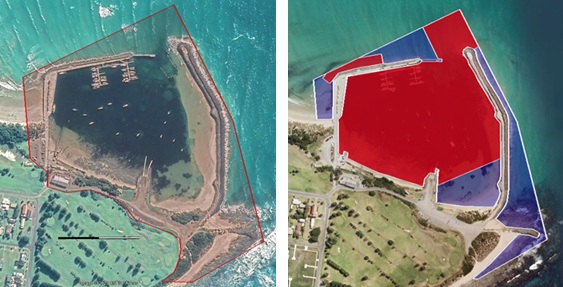
Swimming within the waters of the Port of Apollo Bay has been prohibited since before our management commenced on 1 July 2024. See the map of port waters below.
On-site signage and the Port’s Terms and Conditions of Use available on our website display this information: Port of Apollo Bay - User Terms and Conditions Great Ocean Road Coast and Parks Authority.
As is common in many active local ports and marinas (and is the case at Port of Apollo Bay), a “no swimming” rule is typically adopted due to operational and safety risks.
The set-aside seeks a more balanced approach, one that enables swimming in clearly defined, safe areas while preserving essential port operations.
In considering potential designated swimming areas, we have assessed:
- Operational risks associated with a moving dredge vessel and two fixed outfalls located along the lee breakwater. Establishing appropriate exclusion zones around this infrastructure is essential for safety and effective risk management.
- Operational risks associated with high vessel activity within the inner harbour. This includes vessel movements, manoeuvring, and access requirements.
- Community use of the area adjacent to the boat ramp, and the need to minimise conflict between swimmers, vessel launching and retrieval activities, and maintenance dredging operations when works are underway in the harbour and entrance channel.
Our goal is to thoughtfully balance community access with safety and operational requirements.
The map below (left) shows the entire port boundary where swimming is currently prohibited. The map below (right) creates an area in the Apollo Bay Port waters shown in blue where swimming, snorkelling and diving are allowed (with restrictions, see below).
People can still enter the water in this area, but only if they stay:
- 50 metres away from an operating dredge, and
- 25 metres away from a dredge discharge point.
We are asking for feedback on the proposed set-asides. You are invited to provide your feedback via the Have Your Say survey – click here.
Community engagement
Community feedback was sought on the proposed set-asides from 27 February to 15 March 2026.
We received 61 responses in total, hearing mostly from local residents (67%), and regular visitors (22%).
Those completing the survey nominated a wide range of port user activities, including swimming (92%) fishing (39%), boating (33%), visiting (38%), and other activities (26%), with a small proportion using the port for commercial purposes (2%).
A total of eight set-asides were put forward, across four functional areas of the port as listed above.
Read a summary of each set-aside, community feedback, and what we are doing about it in drop downs below.
Set-aside 1. Prohibition of specified activity/s (swimming, snorkelling and diving)
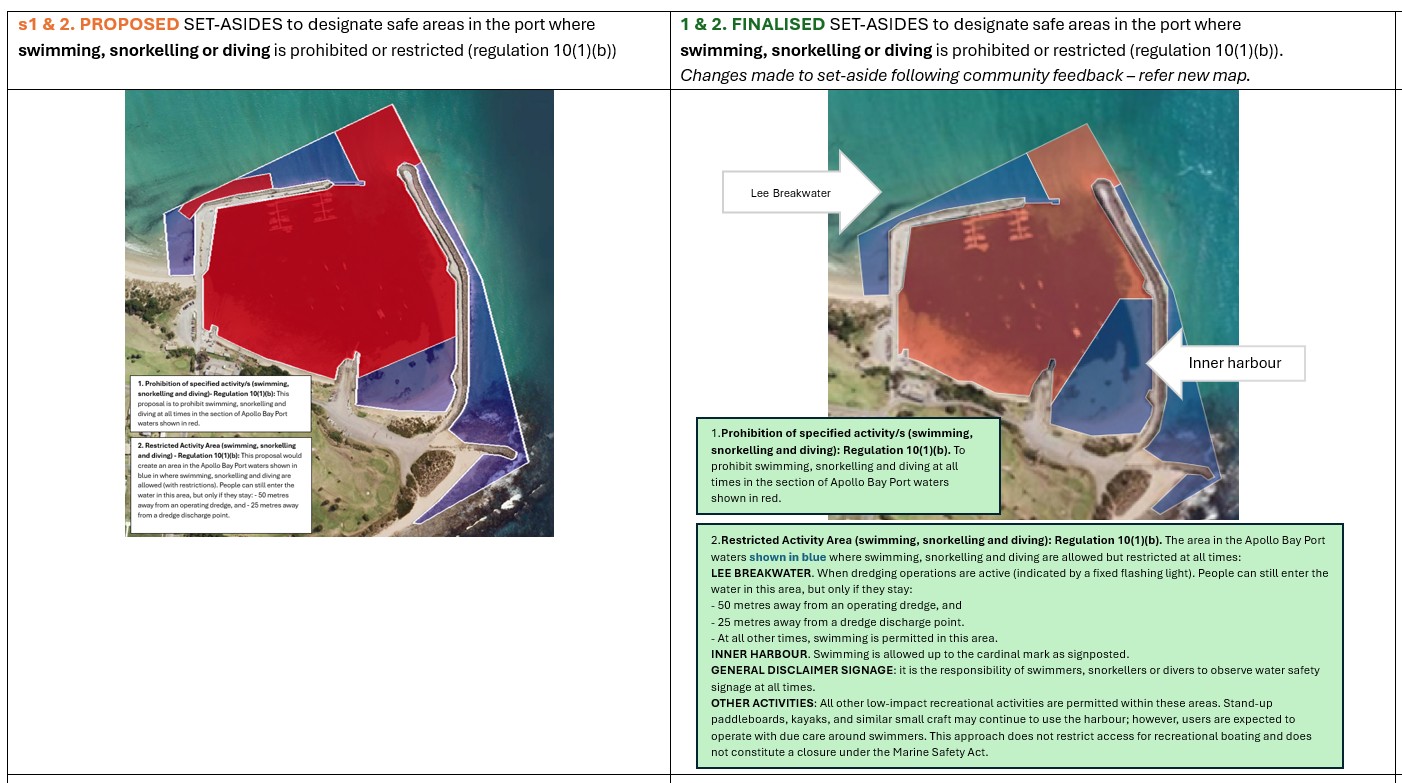
This set-aside prohibits swimming, snorkelling and diving at all times in the section of Apollo Bay Port waters shown in red (refer to maps).
Set-aside 2. Restricted Activity Area (swimming, snorkelling and diving): Regulation 10(1)(b)
This set-aside creates an area in the Apollo Bay Port waters (shown in blue) where swimming, snorkelling and diving are allowed but restricted at all times.
People can still enter the water in this area, but only if they stay:
- 50 metres away from an operating dredge, and
- 25 metres away from a dredge discharge point
Feedback on Swimming, Snorkelling And Diving Prohibitions/Restrictions
Responses highlighted community concern around:
- questioning the need for the changes given decades of incident free swimming alongside port operations
- preserving long-standing recreational use
- flexibility in regulations to accommodate weather-dependent use patterns
- the harbour is a safe alternative during dangerous ocean conditions
- access to the eastern wall during conditions that naturally prevent harbour operations and pose no safety conflicts
- raised issues about communication, noting that swimming had already been prohibited without the community’s knowledge, creating uncertainty and affecting trust
Changes made to these set-asides after considering community feedback
Swimming is prohibited within the Port of Apollo Bay, which is consistent with the approach taken across most active ports in Victoria. This arrangement was in place under the previous port manager and was adopted by GORCAPA at transition.
While on-site signage and the Terms and Conditions of port use communicate this information, this engagement highlighted that this restriction, and the extent of port waters, which extend beyond the inner harbour, has not been widely understood by all users. We have taken this feedback and will endeavour to ensure there is more clarity around port rules and regulations moving forward.
Following a review of community feedback, the set-aside determination has been amended as follows:
- Lee breakwater
The area off the lee breakwater has been reclassified as a restricted swimming zone with conditions. When dredging operations are active (indicated by a fixed flashing light, which will be installed), swimmers must remain at least 25 metres from the dredge outflows and 50 metres from the dredge vessel. At all other times, swimming is permitted in this area. See image below.
- Inner harbour swimming area
The designated swimming area within the inner harbour has been expanded to provide additional space for safe recreational use. Any further expansion beyond the cardinal mark is not feasible, as it would encroach into the dredge rope systems and the vessel navigation channel, thereby increasing the risk of interaction between swimmers and vessels. See image below.
- A disclaimer stating it is the responsibility of swimmers, snorkellers or divers to observe water safety signage at all times has been included
All other low-impact recreational activities are still permitted within these areas. Stand-up paddleboards, kayaks, and similar small craft may continue to use the harbour; however, users are expected to operate with due care around swimmers. This approach does not restrict access for recreational boating and does not constitute a closure under the Marine Safety Act.
Updated map (right side map) of prohibited/restricted swimming, snorkelling and diving areas
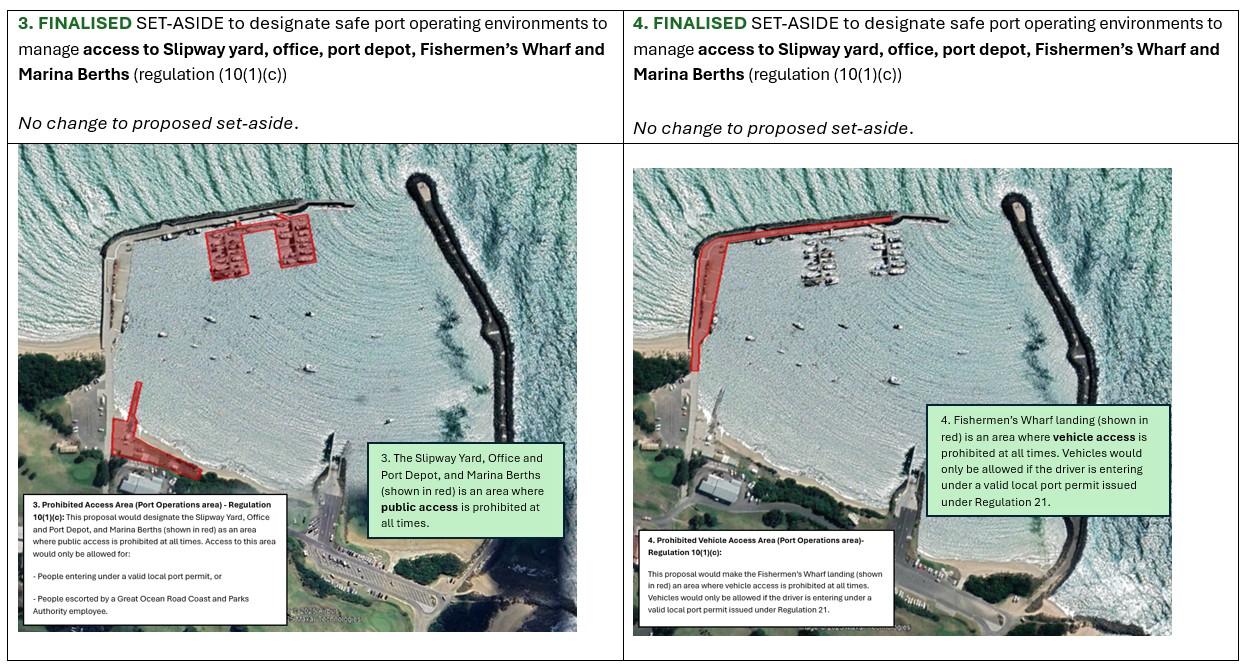
Set-aside 3. Prohibited Access Area (Port Operations area)
This set-aside designates the Slipway Yard, Office and Port Depot, and Marina Berths (shown in red) as an area where public access is prohibited at all times. Access to this area would only be allowed for:
- People entering under a valid local port permit, or
- People escorted by a Great Ocean Road Coast and Parks Authority employee
Set-aside 4. Prohibited Vehicle Access Area (Port Operations area): Regulation 10(1)(c)
This set-aside makes the Fishermen’s Wharf landing (shown in red) an area where vehicle access is prohibited at all times. Vehicles are only allowed if the driver is entering under a valid local port permit issued under Regulation 21.
Feedback on managing access to port operating environments
Feedback generally supported the proposed restrictions in the port operating environments, viewing them as reasonable safety measures that help protect watercraft and port operations. Many felt that limiting public access to working areas and boat berths is sensible and already part of how they use the port. Others noted that much of this access is already controlled through existing fences, gates and key‑card systems, questioning whether additional regulations are necessary and suggesting the changes may create unnecessary work or duplication.
When asked about vehicle access, most respondents supported the proposed restrictions, largely due to concerns about pedestrian safety around the wharf and breakwater. Many felt the measures were sensible and noted that similar access controls already exist, such as the boom gate requiring a local port permit. This led some to question whether the proposal represents a real change or simply formalises current practice, with suggestions that clearer signage and enforcement may be all that’s needed. Key questions were also raised about how permit criteria will be determined, how commercial operators (particularly fishermen unloading catch) will be accommodated, and the importance of ensuring appropriate access for those with special requirements.
What we are doing: No changes are made to the proposed set-asides that designates safe port operating environments.
This measure represents a formal administrative control to support the existing interventions. GORCAPA is working to ensure all application processes are efficient and streamlined to facilitate implementation.
Information for particular existing permit holders:
- For existing non-commercial berth holders, vehicle access will be managed through your next berthing permit process.
For existing commercial operators, including associated transport services interacting with the port, vehicle access for both operators and their contractors will be managed through your next berthing application process.
Three set-asides are proposed to manage safe berthing, mooring or anchoring of vessels:
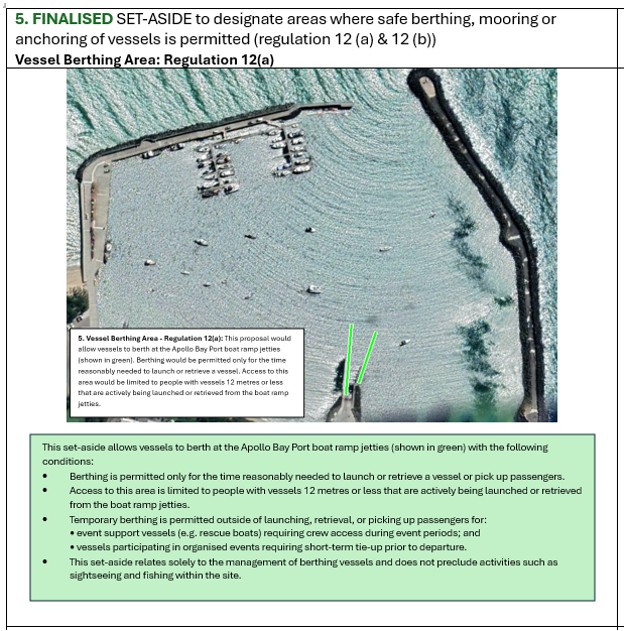
Set-aside 5. Vessel Berthing Area: Regulation 12(a)
This set-aside allows vessels to berth at the Apollo Bay Port boat ramp jetties (shown in green). Berthing would be permitted only for the time reasonably needed to launch or retrieve a vessel. Access to this area would be limited to people with vessels 12 metres or less that are actively being launched or retrieved from the boat ramp jetties.
Feedback on designating areas for vessel berthing
Most respondents supported limiting berthing areas to vessel launching and retrieval, noting this largely reflects current practice. However, some raised concerns that the wording may unintentionally restrict simple passenger pick‑ups and drop‑offs. Others highlighted practical issues for larger vessels and sailing boats, which may require longer or more flexible berthing times for safe operations. Several respondents also questioned whether the proposed restrictions align with the original intent of Better Boating funding, which aimed to support unrestricted recreational access, suggesting that targeted measures (such as limiting overnight stays) might be more appropriate than launch‑only rules.
What we are doing: Clarifications in wording made following community feedback
GORCAPA appreciates the importance of the Harbour to Apollo Bay. While we acknowledge Better Boating Victoria’s commitment to supporting unrestricted recreational access, this also extends to improving ease of access. A key challenge identified in the Victorian Recreational Boating Strategy 2021–2030 is congestion and capacity, with a clear objective to reduce these pressures.
Although this proposed set-aside sought to support this objective, we have taken into consideration feedback and highlight the following amendments:
- Clarification of permitted activities. Inclusion of the wording “or picking up passengers” to ensure this activity is explicitly accommodated.
“Berthing is permitted only for the time reasonably needed to launch or retrieve a vessel or pick up passengers”
- Temporary berthing provisions. Inclusion of the following provision:
Temporary berthing is permitted outside of launching, retrieval, or picking up passengers for:
- event support vessels (e.g. rescue boats) requiring crew access during event periods; and
- vessels participating in organised events requiring short-term tie-up prior to departure.
This set-aside relates solely to the management of berthing vessels and does not preclude activities such as sightseeing and fishing within the site.
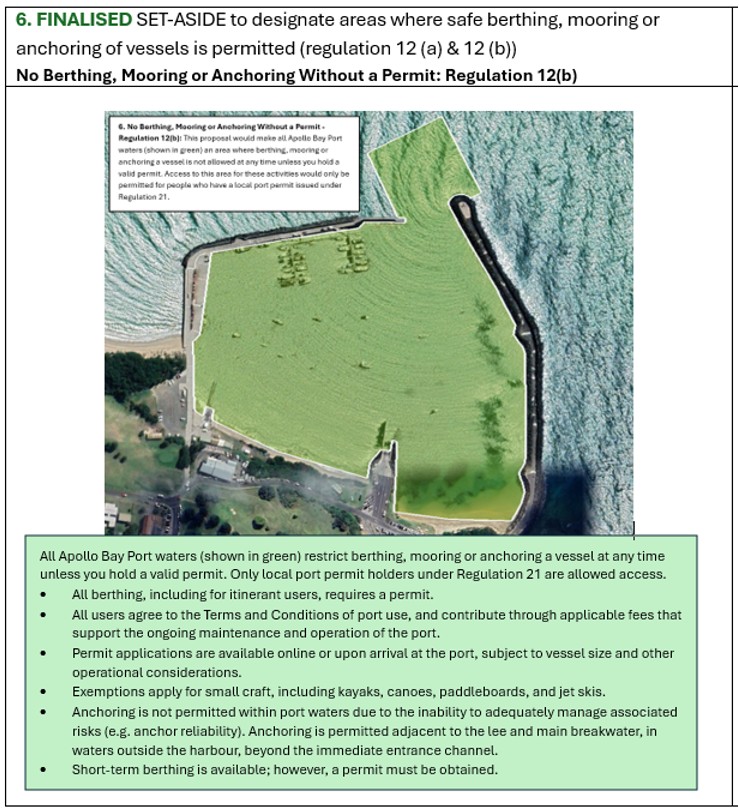
Proposed set-aside 6. No Berthing, Mooring or Anchoring Without a Permit: Regulation 12(b)
This proposal would make all Apollo Bay Port waters an area where berthing, mooring or anchoring a vessel is not allowed at any time unless you hold a valid permit. Access to this area for these activities would only be permitted for people who have a local port permit issued under Regulation 21.
Feedback on designating berthing areas requiring a permit
Community feedback on the proposed harbour management changes was mixed, with some supporting safety and accessibility measures while many others raised concerns about impacts on tourism, accessibility and small‑craft use. Supportive respondents felt the regulations were sensible and largely aligned with existing expectations, particularly around maintaining safe navigation channels. However, many were worried that the changes could negatively affect Apollo Bay’s tourism sector, create barriers through a complex permit system, and limit essential access for short‑notice visitors, commercial operators and small vessels. Respondents also highlighted the need for flexibility—such as temporary anchoring allowances, emergency shelter access, designated swimming areas and short‑term public moorings—to ensure the harbour remains safe, functional and welcoming for all users.
What we are doing: Small changes following community feedback
This set-aside formalises the existing berthing management arrangement at the Port of Apollo Bay. All berthing, including for itinerant users, requires a permit. This arrangement was originally established under the previous port manager and adopted by GORCAPA to ensure continuity of service.
Formalising this approach ensures that all users are properly recorded, agree to the Terms and Conditions of port use, and contribute through applicable fees that support the ongoing maintenance and operation of the port.
GORCAPA is also working to ensure application processes are efficient and streamlined to support timely access. Permit applications are available online or upon arrival at the port, subject to vessel size and other operational considerations.
In response to stakeholder feedback, clear exemptions have been introduced for small craft, including kayaks, canoes, paddleboards, and jet skis.
While the permit requirement is outlined in the Terms and Conditions of port use, recent engagement has highlighted that this has not been widely understood by all users. GORCAPA acknowledges this feedback and will take steps to improve communication, clarity, and awareness of applicable rules and requirements.
Temporary anchoring
Anchoring is not permitted within port waters due to the inability to adequately manage associated risks (e.g. anchor reliability) and therefore cannot be supported. However, this prohibition does not apply to designated waters outside the harbour, beyond the immediate entrance channel, where anchoring is permitted adjacent to the lee and main breakwater. See set aside image below.
Short-term berthing
Short-term berthing is available; however, a permit must be obtained.
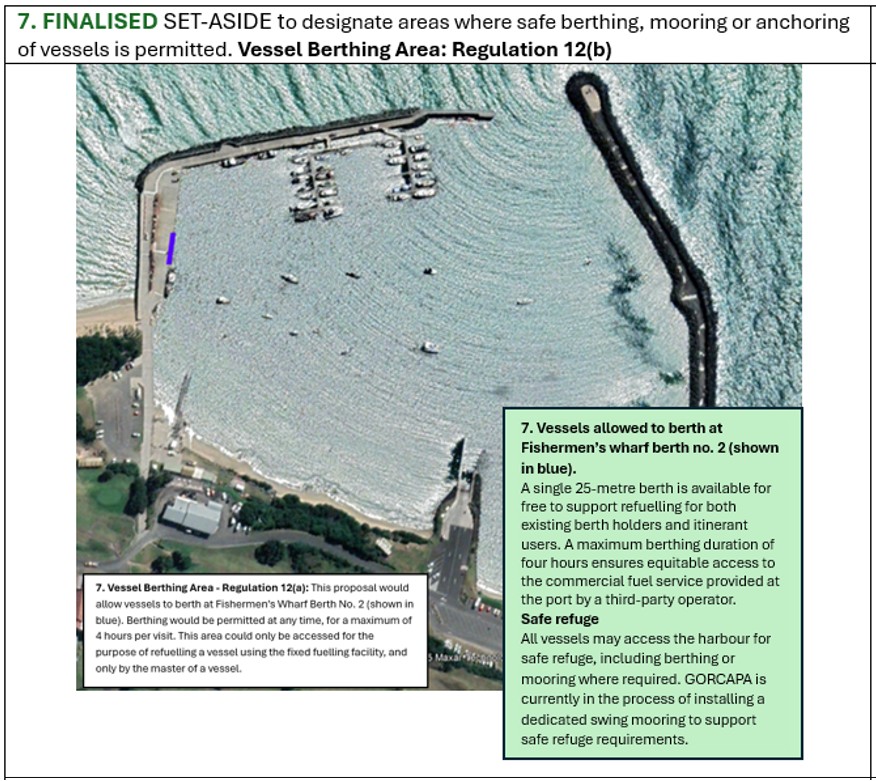
Proposed set-aside 7. Vessel Berthing Area: Regulation 12(b)
This proposal would allow vessels to berth at Fishermen’s Wharf Berth No. 2. Berthing would be permitted at any time, for a maximum of 4 hours per visit. This area could only be accessed for the purpose of refuelling a vessel using the fixed fuelling facility, and only by the master of a vessel.
Feedback on berthing at Fishermen’s Wharf Berth No. 2
Community responses to the proposed wharf‑use regulation were mixed, with most people expressing support or neutrality, while a smaller group raised operational and safety concerns. Supportive respondents felt the proposal was reasonable, aligned with current practice, and made sense for managing the space. However, others highlighted practical issues, including limited space, the need for longer or more flexible time allowances; particularly for commercial fishers- and the importance of accommodating rest periods to ensure safe vessel operation. Some also emphasised the role of fishing in supporting tourism and the need to preserve the harbour’s function as a safe refuge during bad weather. Overall, while many were comfortable with the proposal, several operational and safety considerations will require careful attention before finalising any changes.
Our response: No changes to the proposed set-aside.
This set-aside provides clarity that a single 25-metre berth is available for free (no permit required) to support refuelling for both existing berth holders and itinerant users. A maximum berthing duration of four hours has been established to ensure equitable access to the commercial fuel service provided at the port by a third-party operator.
Safe refuge
All vessels may access the harbour for safe refuge, including berthing or mooring where required. GORCAPA is currently in the process of installing a dedicated swing mooring to support safe refuge requirements.
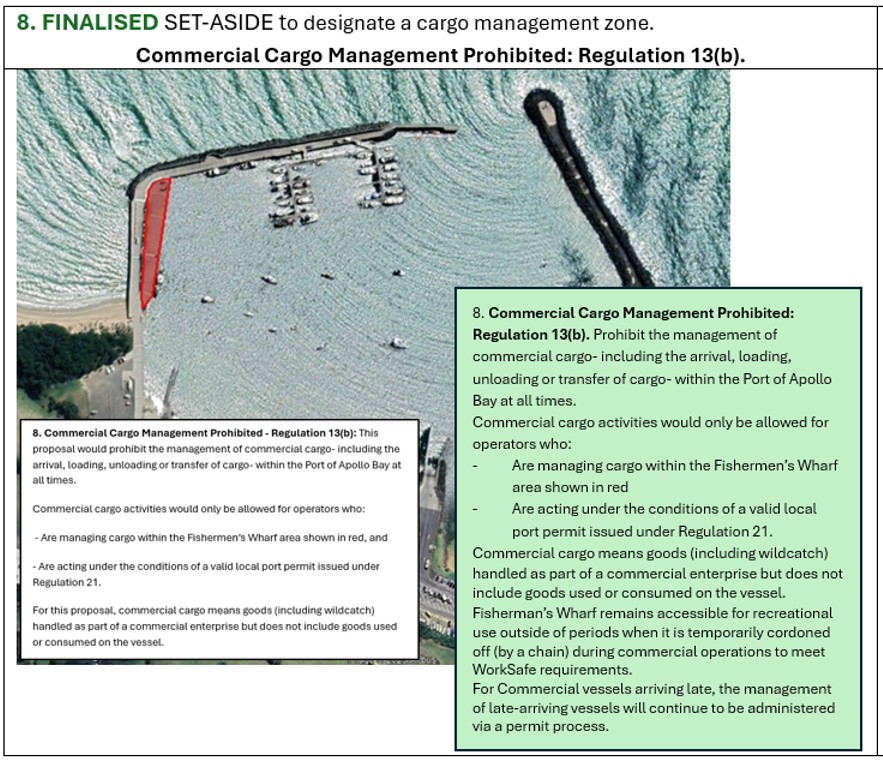
Set-aside 8. Commercial Cargo Management Prohibited: Regulation 13(b)
This set-aside prohibits the management of commercial cargo- including the arrival, loading, unloading or transfer of cargo- within the Port of Apollo Bay at all times. Commercial cargo activities would only be allowed for operators who:
- Are managing cargo within the Fishermen’s Wharf area shown in red in Attachment G, and
- Are acting under the conditions of a valid local port permit issued under Regulation 21.
For this set-aside, commercial cargo means goods (including wildcatch) handled as part of a commercial enterprise but does not include goods used or consumed on the vessel.
Feedback on cargo management
Community feedback showed a mix of views on the proposed changes to harbour access and commercial operations, with many emphasising the need to balance public access with the realities of a working port. A strong portion of respondents supported prioritising commercial fishing activity, noting its importance to local livelihoods and the daily presence of operators who rely on unrestricted access. Others were concerned that new restrictions could limit the harbour’s functionality and economic potential, potentially shifting it away from its identity as a working port. Questions were also raised about how visiting commercial vessels would be managed, especially those arriving after hours. Overall, the feedback highlighted the need for practical solutions - such as gated fencing and clear policies to ensure both commercial operations and public access can be supported effectively.
What we are doing: No changes made to the proposed set-aside for cargo management.
The commercial cargo management zone formalises the existing dedicated area for cargo handling. This administrative control complements the recently installed fencing, which further delineates the site. As such, the Fisherman’s Wharf remains accessible for recreational use outside of periods when it is temporarily cordoned off (by a chain) during commercial operations to meet WorkSafe requirements.
Managing access via permits:
For existing commercial operators, formal approval to manage cargo within this area will be incorporated into the next berthing application process, transitioning to a combined berthing and cargo management permit. In the interim, access to this area has been automatically applied under existing berthing approvals.
For new commercial operators, approval to use this area will be granted through an application for a berthing and cargo management permit.
Commercial vessels arriving late
The management of late-arriving vessels will continue to be administered via a permit process.
Maps of Set‑Aside Areas
Image 1 of 6
Port Management Regulations and Proposed Set‑Asides
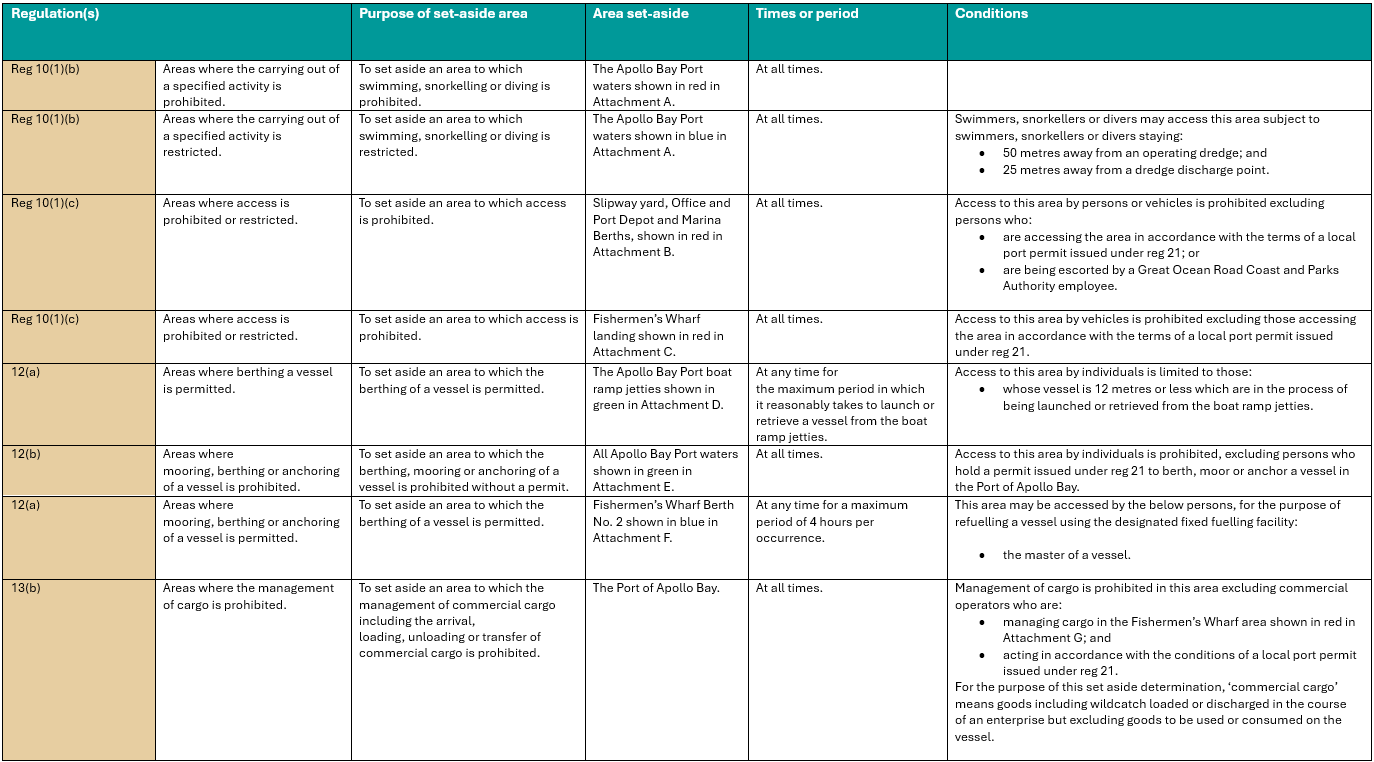
Image 1 of 6